




- Joined
- 31.10.19
- Messages
- 1,369
- Reaction score
- 4,570
- Points
- 113

Developers are making Bluetooth more secure every year but it's still vulnerable, as I'll show in this article... So today we will talk about:- Bluetooth Basics.
- Main Linux Tools.
- Bluetooth Protocol Stack.
- Bluetooth Security.
- Bluetooth Hacking Tools in Kali.
- Several Bluetooth Attacks.
Bluetooth Basics
- Name
- Class
- List of services
- Technical information
The so-called piconet is a network where there is one main and up to seven additional devices. The protocol constantly changes frequency (1600 times per second) so one device doesn't interfere with others. The chance of two devices operating on the same frequency is extremely low.
Main Linux Tools
The implementation of the Bluetooth protocol stack in Linux is called BlueZ. It's usually installed in Linux distributions by default or it can be found in repository. All the tools are included in BlueZ. These tools include:
- hciconfig: This tool is similar to ifconfig in Linux but provides information only about Bluetooth devices.
- hcitool: This tool is for data inquiry. It provides a lot of information such as the device name, identifier, class and clock signal.
- hcidump: This tool is my favorite - it simply captures all Bluetooth communications.

Bluetooth devices are not required to use all protocols in the stack (e.g, TCP/IP). The Bluetooth stack is designed to allow various communication applications to use Bluetooth for their purposes. A program will use only one vertical slice of this stack. Next are the Bluetooth protocols:
- Cable Replacement Protocol: RFCOMM.
- Main Bluetooth Protocols: LMP, L2CAP, SDP.
- Telephony Control Protocol: TCS Binary, AT-commands.
- Borrowed Protocols: PPP, UDP/TCP/IP, OBEX, WAP, vCard, vCal, IrMC, WAE.
Bluetooth Security
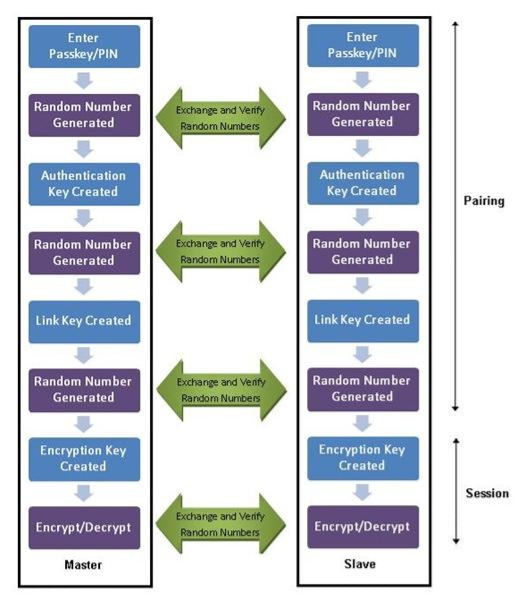
Bluetooth security is based on several principles. The first is the abrupt frequency change. The frequency change algorithm is available to the master and slave devices but not to third parties. The second is the secret key; devices exchange it during pairing. It's used for authentication and encryption (128-bit). There are only a few Bluetooth security modes. More details about them:
- Security Mode 1: Active protection is disabled.
- Security Mode 2: Service-level protection. Authentication, configuration and authorization are managed by a centralized security manager. Users cannot activate it themselves. There's no device-level protection.
- Security Mode 3: Device-level protection. Authentication and encryption based on a secret key. Always enabled. Enforces protection for low-level connections.
Bluetooth Hacking Tools in Kali
As we know, Kali has several tools for Bluetooth hacking. But some we may have to find and download. To find out which tools for working with Bluetooth are already installed and ready to use, open Applications > Kali Linux > Wireless Attacks > Bluetooth Tools.
- Blueranger: A simple Python script that uses i2cap signals to detect Bluetooth devices and determine the distance to them.
- Bluelog: A tool that finds Bluetooth devices. It scans the area around you for visible devices and stores them in a file.
- Bluemaho: A set of tools with a graphical interface for testing the security of Bluetooth devices.
- Btscanner: This tool with a graphical interface scans visible devices within the working range.
- Redfang: This tool finds hidden Bluetooth devices.
- Spooftooph: A tool for Bluetooth spoofing.
Several Bluetooth Attacks
- Bluesmack: A DoS attack against Bluetooth devices.
- Blueprinting: The process of footprinting (network mapping).
- Bluesnarfing: This attack steals data from a Bluetooth-supporting device. Includes messages, calendar, images, address book and chats.
- Bluejacking: The attacker sends "business card" to the victim. After the user adds it to their contacts, you can receive additional messages.
- Bluebugging: This attack gives control over the target phone. An application Bloover has been developed for automatic execution of this attack.

